great looking tanks too!

 Web Member
Web Member
Web Member

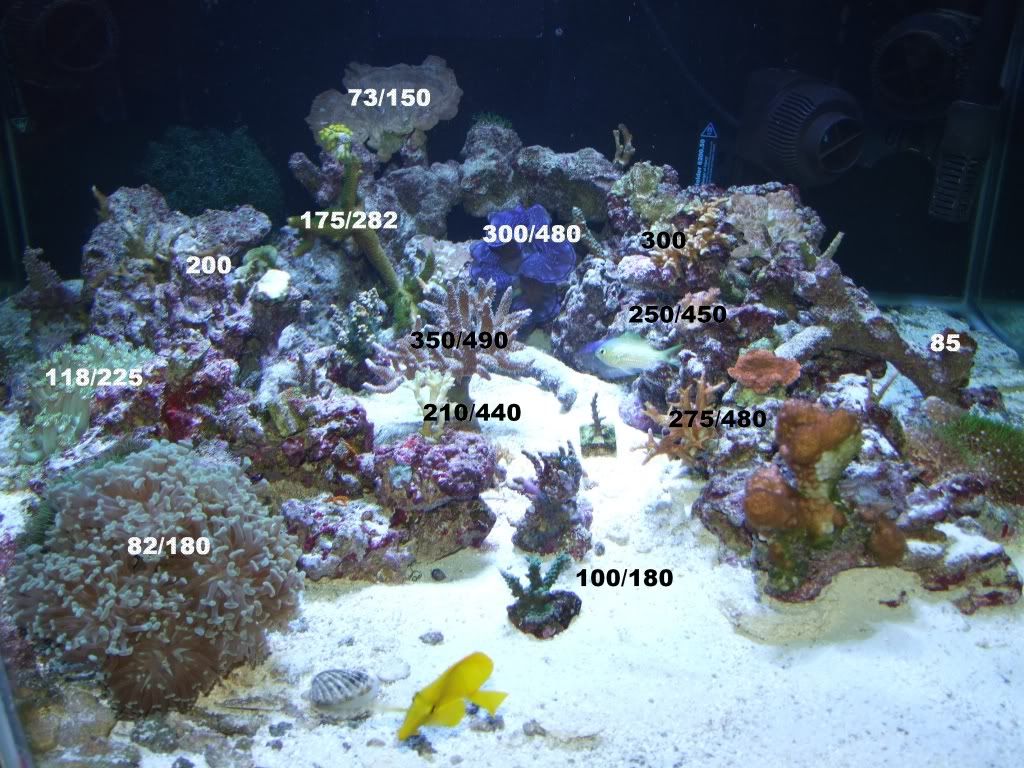
I am almost finished with the Par Meter...thought I would post up the results...I played with the exposure of the pic to get the text to stand out a little, the back sections were too dark so the front is a little overexposed.
The equipment, a single 150 watt HQI Reefcube (M81). I tested two different bulbs, the first number is a 20K Radium and the second number is a 10K XDE, both in a LumenArc III Mini, if there is only one number, it is the Radium as I did not test all areas with the 10K. 40x40x17" Pentagon, rock arranged in a 24-30" cove. Most corals reside around the perimeter of the cove. Most of the corals are 18-20" in height from the bulb.
Par at the glass shield was 1200 for the Radium and 2200 for the 10K
Par at the water surface, 9" from the bulb, Radium at 780 and the 10K at 1900.
It is interesting that I am bleaching new additions and have been since I set up the tank. I am starting new additions out on the perimeter and moving them closer weekly.
I may test the 250 watt Phoenix with an ARO electronic ballast, but I may not, I don't plan on using the light, I don't think I will be needing more Par than the Radium is giving me. I am very happy and a little surprised by the results, I was expecting much lower numbers and was going to add a 4-24 wall LET Retro with Blue Plus bulbs, I don't think I will need to do that.
Web Member
This is a 125 fowlr tank. I replaced the 54w t5 bulbs with a rapidled.com retrofit kit. I used aluminum c-channel from lowes as a heat sink. I have two strips about 6' each. One has 12 cool white xp-g r5 leds with 80 degree lenses. The other has 12 royal blue xp-e leds with 80 degree lenses. The lights are about 8 inches from the glass lids. The glass covers the entire tank in order to keep the eels inside. There is a 1 inch gap between the glass and the top of the water. The par readings are not that great but considering how high the lights are, the wide lenses, and a dirty glass cover I think they are reasonable. I have some gsp on top of one rock and on the sand bed. Both seem to be doing fine. I think if I switched to 60 degree lenses and dropped the lights down 5 inches I would get double the par.
These reading are from a rapidled.com par38 bulb. The bulb is 17w with 7 leds and 80 degree lenses. They are 3 Royal blue, 1 blue, 2 cool white, and 1 warm white. I wanted to compare this bulb to my evil's par38 with has 3 royal blue and 2 cool white. I only saw a slight difference in the colors. I used an orange ricordea for comparision. The big difference was in the par. Because the evil par38 has more watts and 60 degree lenses it had higher readings in my other post. I prefer the par and the colors from my 5 led bulb. I think the rapidled bulb would be better for a smaller nano tank. The picture shows all the bulbs on, but I tested the bulb with the other two off.

Jacob
Web Member2
I was expecting higher numbers for those par38 bulbs as I was looking to add one to the frag tank. I like that you compared the two though as I was debating between these.
Kevin- 375 Gallon Reef
Reefing made easy...
Web Member
Well, the evil par38 have great par for the money. Plus, mine are 8" from the water surface. I think just by switching to 40 degree lenses you can get a 50% boost or lower the bulbs. Next time I would like to take measurements from different heights. I also wanted add them to my 180g with 3 t5s on at the same time. I think I could get a good mix of color from the t5's and shadow effect from the par bulbs.Originally Posted by kkiel02

Jacob
Web Member2
I might try the evil par38 then. I also saw reefkoi's par38 but that little fan in there worries me if it goes out.
Kevin- 375 Gallon Reef
Reefing made easy...
 Web Member
Par Results are in:
Web Member
Par Results are in:
Who do I need to talk to about having them come out to test all my par readings
Reef Freaks
Thank you
Reef Freaks
Web Member
Does anybody know where I can find PAR readings for AI Vegas? If they're not available, I can measure and publish some. All I need is a PAR meter.
Jack
Big whorls have little whorls, Which feed on their velocity;
And little whorls have lesser whorls, And so on to viscosity
Lewis Richardson in 1922
Web Member2
Web Member
Awesome! Thanks!
Jack
Big whorls have little whorls, Which feed on their velocity;
And little whorls have lesser whorls, And so on to viscosity
Lewis Richardson in 1922
 Posting Permissions

 Reply With Quote