

You're actually spot on Ruben... Seriously. You must be one of those psychics or something. Do you have ESPN???Originally Posted by jrsatx20

-David

 Web Member

You're actually spot on Ruben... Seriously. You must be one of those psychics or something. Do you have ESPN???
-David
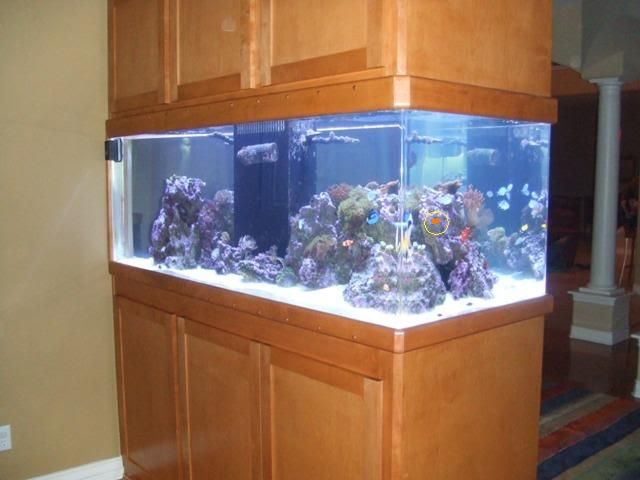
40 Gallon Breeder on Steroids!!!
Where You'll Find An Acan, Dendro, and Orange Ricordea Garden In Bloom.
Web Member

not far off....
here is the end of the tank

Web Member
LOVE THE RBTA ON THE RIGHT TOP. NICE TANKS DRMARK
Web Member
I love that little dendrophylia (no spell check). Anyway, nice!
Web Member
Mark - Did you get your system set up in a way that avoids frequent on/off cycling?
Russ
SPONSOR
RO and RODI Systems and Supplies
www.BuckeyeHydro.com for all your water purification needs
Info@BuckeyeHydro.com
Web Member
Not yet.
I manually turn it on and off at the faucet under the tank.
If I leave it on, there is quite a bit of back pressure under current setup. Not sure that is a good idea.
Long term I will need to fabricate a custom shaped topoff resevoir to fill on an as needed basis that will fit in the one spot I have left under the tank.
Cant find any other solution!!
Thanks for checking in!
mark
Web Member
OK. Sounds like you have the right idea - you sure don't want tank water syphoning back into the RO membrane housing. If you can, at least until you get something else set up, install a check valve or keep the end of the DI output tube above the water level so there is no risk of water flowing backward in the system.
Russ
SPONSOR
RO and RODI Systems and Supplies
www.BuckeyeHydro.com for all your water purification needs
Info@BuckeyeHydro.com
Web Member
So what is an acceptable size for a top off container to avoid the TDS problem with cycling?
Also, if I use the use the RO unit for drinking water and the icemaker, doesn't that create the same cycling problem? And what is available to correct that?
John Roescher
Web Member
I like a setup where the reservoir is about 1.1 times the weekly evaporation - that way you can make water once a week. Then let the filled reservoir feed a float valve in your sump.
Yes - the same condition exists with a pressure tank. A membrane's rejection rate is specified under specific conditions - you've probably heard at least some of these before. For example, for Filmtec 75 gpd membranes: 77 degree F feedwater, 50 psi, 250 ppm softened feedwater, and 15% recovery. Let's talk now about that "50 psi."
This is really a measure of "transmembrane pressure" - that is, the difference between the high pressure (feedwater) side of the membrane and the low pressure (permeate) side of the membrane (osmotic pressures also come into play but we'll omit that discussion here for clarity). So let's look at a couple example situations.
Example 1: 60 psi feedwater and 3 psi in the permeate tube. This would yield a net driving force/transmembrane pressure of 57 psi.
Example 2: 60 psi feedwater and 38 psi in a permeate tube that feeds a nearly full pressurized tank. This would yield a net driving force/transmembrane pressure of only 22 psi.
Because rejection rate is directly proportional to transmembrane pressure (as net driving pressure goes up, so does rejection), you can expect the rejection rate of the membrane in Example 2 to be considerably lower than the rejection rate of the membrane in Example 1.
A note on drinking water RO systems - people are generally less demanding in terms of final tds for drinking water systems than they are for aquarium use.
The other thing you can do with a drinking water (only) system is use a membrane with a lower gpd rating.
Russ
SPONSOR
RO and RODI Systems and Supplies
www.BuckeyeHydro.com for all your water purification needs
Info@BuckeyeHydro.com
 Posting Permissions


 Reply With Quote