UPCOMING: Events

Results 1 to 10 of 10

Thread: Dentistry and Your Fish - A Must Read!

  1. #1
    Join Date
    09-16-2008
    Location
    San Antonio
    Posts
    3,831

    Talking Dentistry and Your Fish - A Must Read!

    Hello. I'd like to start highlighting some of the responsibilities we, as reef keepers, have to maintaining healthy, happy marine inhabitants. I'll be touching on ethical issues like fish and coral that are more suitable for aquarium life, as well as which ones should not be kept in the aquarium. Also, the status of our reefs, proper aquarium husbandry, and many sub points. The goal is for us to gain useful knowledge that propels us into a higher standard of reef keeping. Hopefully, we will all learn new things and also reiterate and reemphasize key points that are sometimes over looked.


    For my first thread I would like to start w/ Dentistry and Your Fish:

    Tetraodontiform Fishes (Puffers, File fish, Triggers, and porcupines) are common pets for marine aquarists. They are a striking group of fish that come in a variety of colors, shapes, and personalities. However, each of these fishes have at least one thing in common: Their teeth may out grow their mouths, especially Puffer fish, and risk starving to death if not properly cared for while in our custody.. Wrasses are also susceptible to similar fate.


    Fortunately, this can be avoided by offering a proper diet and environment. In the wild, fish use their sharp teeth or bills to crush through crab and lobster shells, clams, or fish bones on a daily basis. They are not afforded the same opportunities if we are only feeding mysis, squid, flakes, and or pellets. With a little extra effort we can correct this dilemma.


    Finding an LFS that carries live lobsters, crabs, and clams meant as feeders can be problematic. However, we have other options. Saltwater hermits and snails are relatively cheap and offer good sources of nutrition. For larger fish you might offer crayfish. I've fed crayfish to triggers and eels. Trust me.....it's dinner and a show Also, look for raw (not frozen) shrimp that still have the shell. Crab legs work too, but you should probably invite me over to help eat supervise. Now, not all of these fish are monster carnivorous. Let's say you have a file fish. Lathering a dead coral skeleton with a food paste would provide a great simulation to the way they graze in nature.


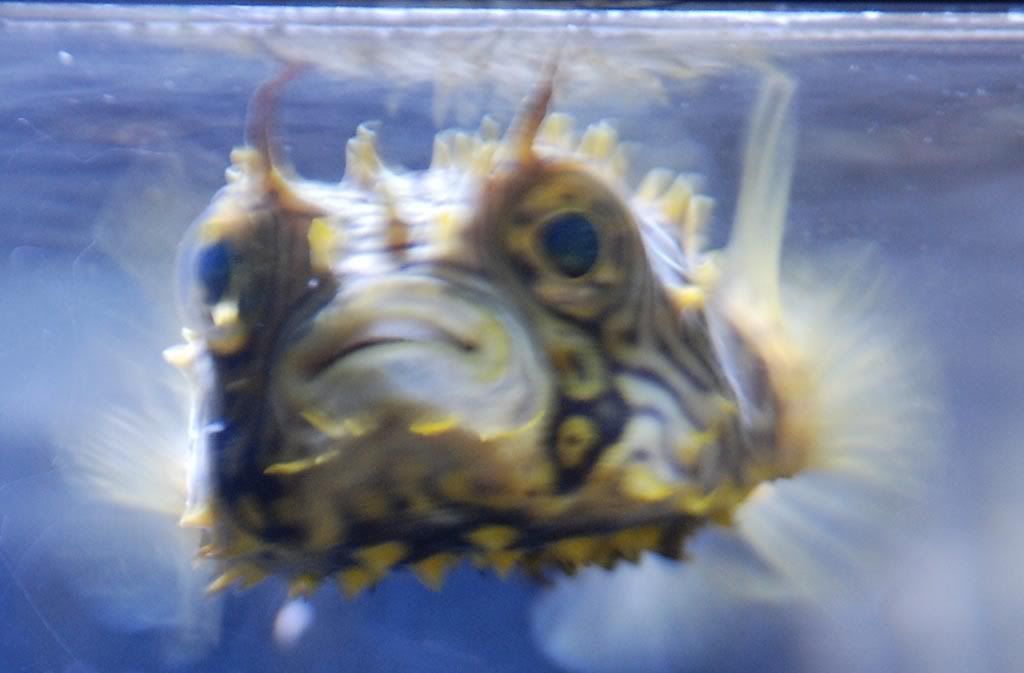
    I started with prevention since we usually purchase our fish in their juvenile and teenage stage. When purchasing an adult it is still important to pay attention to their teeth. Especially if you are purchasing one that is not a recent wildcaught specimen. Look for signs like it's not eating well or appearing to smile at you like Gary Busey


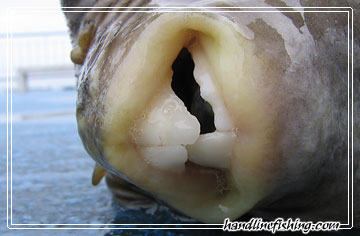
    As previously state, Puffer fish are more prone to overgrown teeth. Should your fish have trouble eating because it's bill has outgrown it's mouth,
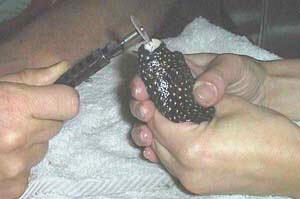
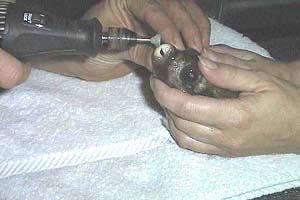
    It may be necessary to file their bill down.

    Things you'll need:
    2 buckets
    Dremel (or wire cutters)
    Clove oil
    Camera (because you know we'll never believe you did it without proof)

    ************Disclaimer: Clove oil is a sedative at low doses. If you over dose it will kill your fish. Please do your own research and understand the risks before attempting. The directions below are meant to be a generic guide. I repeat, do your own research and be fully aware of the risks before attempting this at home. I, and anyone else, am NOT responsible if you kill your fish************

    Take an appropriately sized container and rinse it in tap water thoroughly to ensure no soap residue. Fill it with aquarium water. Amount will vary per size of the puffer, but around 4 drops of clove oil per liter of water is the maximum you want to use. For weak or smaller fish a smaller dose will be necessary.

    It shouldn't take long for you puffer to go to dreamland. Once it does, have someone hold the fish steady while you file down the bill. A dremel may be too much for smaller fish so wire cutters might work better.

    Your second container will have fresh tank water for you to dip and wake your fish up when you are finished.

    Do not dose your aquarium w/ clove oil. Research shows it can kill coral.


    For more on this method and others please see this article:
    http://www.wetwebmedia.com/ca/volume...ry/puffer2.htm

    Other articles on the topic of this thread:
    http://www.suite101.com/content/taki...h-teeth-a86016

    http://www.ehow.com/how_5153607_trim...ish-teeth.html


    Possible next topic: Clove oil - Sedation and Euthanasia. Let's see how much interest there is in it first.
    Last edited by justahobby; Thu, 5th May 2011 at 02:34 AM.
    Justin


    "Only bad things happen quickly in this hobby"

  2. #2

    Default

    Wow ! Sleeping with the Fishes haha

    I'm glad ill never have to do this risky procedure on my Triggers.

    Justin you'd love the weekly Show in my 210 Fowlr. I feed Mussels, Clams, Shrimp, and Crawfish to aid in Healthy Dental Care lol

    However really enjoyed reading this post. Thanks for sharing
    Salty Life and Wett Talk, that's my Daily Cup of Coffee
    600 Reef 480 Shark 60 Frag


  3. #3
    Join Date
    03-04-2005
    Location
    NE San Antonio
    Posts
    11,696

    Default

    great post justin!
    Ace
    The Shade Tree Craftsman


  4. #4

    Default

    Wow... thanks for the reminder that we don't EVER want to have to do the clove oil trick on our sweet little puffer fish! I think that would scare me as much as the fish.

    I had heard before that it is good for the "beak" for them to have something to gnaw on now and then. We've done a variety of different foods to assist with that (mussels in shells that have to be broken open and pieces of silversides that have bones in them) but only do so occasionally... I wonder how you know if you are doing enough prevention? Any photos of what to look for in a buck-tooth pufferfish? I never thought this would apply to the triggers because ours routinely gnaws on rocks (and the occasional hermit crab too.)

    Side note: I love this idea of discussing and exploring some important issues of how we each can strive to be more responsible with the animals we care for and can think of a bunch of other topics along this line. I wonder if we could group them somewhere for reference though?
    http://www.millan.net/minimations/sm...riumsmile1.gif - Kristy and Mike -

    210 g reef tank started 3/15/08; 20 g hex reef tank started 1/3/08, ended 3/30/14

    "I must be a mermaid.... I have no fear of depths and a great fear of shallow living." - Anais Nin
    "To travel is to take a journey into yourself." - Danny Kaye

  5. #5
    tebstan Guest

    Default

    Clove oil is what Richard Hess recommended to use as an anesthetic for swim bladder surgery on my oranda. He assured me it was a simple procedure, but I still enlisted help from Dr. Kirlin at Eagle Veterinary Hospital.

    The hardest part was locating clove oil. It is popular as a home remedy, but high quality oil isn't available everywhere. There are different grades of clove oil, depending on what part of the plant it is made from.


    Justahobby, any ideas on what will help a puffer with a broken/missing tooth?

  6. #6
    Join Date
    02-25-2008
    Location
    Way out West. Culebra and 1560
    Posts
    5,347

    Default

    Here's a pic of my first striped burrfish with his lips pressed against the glass. It made him look like Gary Busey.
    200g-No Corals Yet!


  7. #7

    Default

    Hahaha
    Salty Life and Wett Talk, that's my Daily Cup of Coffee
    600 Reef 480 Shark 60 Frag


  8. #8
    Join Date
    09-16-2008
    Location
    San Antonio
    Posts
    3,831

    Default

    Pics:


    Justin


    "Only bad things happen quickly in this hobby"

  9. #9
    Join Date
    09-16-2008
    Location
    San Antonio
    Posts
    3,831

    Default

    Quote Originally Posted by Scream311 View Post
    Wow ! Sleeping with the Fishes haha

    I'm glad ill never have to do this risky procedure on my Triggers.

    Justin you'd love the weekly Show in my 210 Fowlr. I feed Mussels, Clams, Shrimp, and Crawfish to aid in Healthy Dental Care lol

    However really enjoyed reading this post. Thanks for sharing

    Sounds great. My favorite part of aggressive tanks is feeding time

    Quote Originally Posted by hobogato View Post
    great post justin!
    Thanks Ace
    Quote Originally Posted by tebstan View Post
    Clove oil is what Richard Hess recommended to use as an anesthetic for swim bladder surgery on my oranda. He assured me it was a simple procedure, but I still enlisted help from Dr. Kirlin at Eagle Veterinary Hospital.

    The hardest part was locating clove oil. It is popular as a home remedy, but high quality oil isn't available everywhere. There are different grades of clove oil, depending on what part of the plant it is made from.


    Justahobby, any ideas on what will help a puffer with a broken/missing tooth?
    Missing how? Like in one of the pics above? Thanks for sharing your experience w/ clove oil. I had to stress that it could be fatal since there will be someone to go overboard even with a disclaimer : P But it is certainly a good option for medical treatment. Seahorses keepers use it for tube feeding sick, malnourished ponies.
    Last edited by justahobby; Fri, 6th May 2011 at 08:21 PM.
    Justin


    "Only bad things happen quickly in this hobby"

  10. #10
    tebstan Guest

    Default

    Quote Originally Posted by Justahobby View Post
    Missing how? Like in one of the pics above? Thanks for sharing your experience w/ clove oil. I had to stress that it could be fatal since there will be someone to go overboard even with a disclaimer : P But it is certainly a good option for medical treatment. Seahorses keepers use it for tube feeding sick, malnourished ponies.
    A whole top tooth is missing. I find myself talking at him with a lisp...


    Richard Hess has a great detailed explanation in his book on fancy goldfish, but since it's copyrighted and I'm lazy here's a quick summation of his technique.

    1. Have 3 vessels of water.
    a. First vessel will have 5 drops of oil of cloves per gallon.
    b. Second vessel will have 2.5 drops of oil of cloves per gallon.
    c. Third vessel will contain no oil of cloves.
    2. Emulsify the oil of cloves before adding it to the vessels. (Add a little water and shake it up.) This ensures it is evenly distributed.

    3. Place the fish in the first vessel until it stops flopping about but is still breathing regularly.
    a. Do not wait until all motion has stopped! Or until breathing has stopped. This will cause euthanasia.
    b. Depending on temperature and size of the fish, it can take from 5 to 15 minutes.
    4. Place the fish in the third vessel of clean water for a few minutes to prevent euthanasia.

    5. Place the fish in the second (half dose) vessel until the procedure is complete.

    6. Do not get so distracted by the procedure that you forget to monitor the fish.
    a. If the fish begins to move around a lot, place it in the first (full strength) vessel for a minute, then back to the second (half dose) vessel.
    b. If the fish slows it's breathing further, place it in the third (clean) vessel for a minute, then back to the second (half dose) vessel.
    7. When the procedure is complete, put the fish in a clean quarantine tank by itself for recovery. "Walk" the fish around by hand until it regains some motion on it's own. It can take over 15 minutes to revive from oil of cloves anesthetic.

    8. If you are not comfortable with this procedure, don't do it. Accidental euthanasia is possible.
    Last edited by tebstan; Sat, 7th May 2011 at 12:13 AM.

Tags for this Thread

Posting Permissions

  • You may not post new threads
  • You may not post replies
  • You may not post attachments
  • You may not edit your posts
  •